Introduction
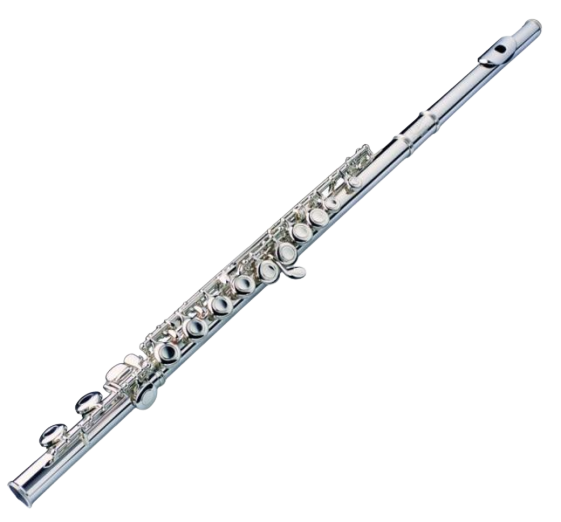
This is the modern flute, a common wind instrument. Flute is a treble melodic instrument use in modern orchestral and chamber music, belonging to the category of woodwind instruments. As shown, it’s normally composed of silver. However, its material and its structure went through many improvements and edits. The major developments of the modern flute occurred during the 1700s and 1800s and were largely a product of Johann Joachim Quantz and Theobald Boehm (Vitullo, 2013).
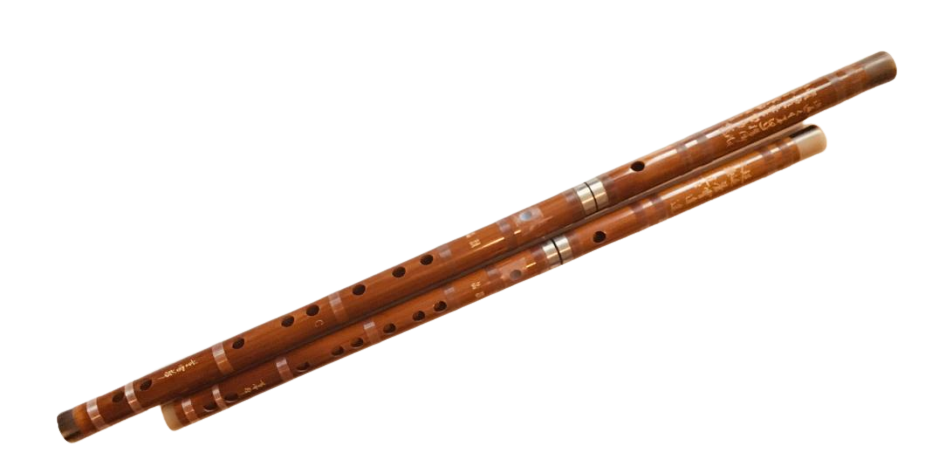
Similar to flute, in China there is a instrument with similar structure and function: Chinese Bamboo Flute.
Chinese Bamboo Flute is also a wind instrument used in traditional Chinese music that originates since 9000 years before. Chinese Bamboo Flute has been one of the most ancient and most representative instrument of Chinese Han people that has a lasting impact on Chinese history and culture.
The history of flutes
The early form of flute is a hollow tubes with holes carved out that fingers could cover. During that period, the primitive flute was played vertically pointed toward the ground. As the new design of a flute produced the sound D#,which was played by pressing the key with the right hand little finger to lift the hole-covering. At this early stage, intonation problems were common because for certain notes common used, like G# Db, Bb, no fixed keys were produced for these keys and holes had to be partially covered by the fingers to produce these notes.
Soon, as time proceed, as the keys of the flute add in its number, flute grown popular through time. Johann Joachim Quantz was one of the most important contributors to the development of the flute. His main contributions to the flute includes his new perspective on the intonation problem. He tried to separate the 2 keys, D# and Eb, although these refer to the same note but he tried to perform these 2 keys on different keys .
The most well-known contributor and the one who improved the flute the most is Theobald Boehm. Boehm was inspired by his interest in construction, key mechanism, and tuning of the flute. In 1828, after Boehm set up his own flute factory, he was unsatisfied by the current construction for flutes. Therefore in 1832, his new idea for the key mechanism of the flute was born. The structure of the flute now has metal posts screwed into the wood of the flute, and the keys were hinged on small axles positioned between the metal posts so that they could pivot to open and close the keys. This is the ring-key system. Boehm’s effort marks a shift of the flute from an out-of-tune, elementary state to a scientifically-accurate, in tune music.
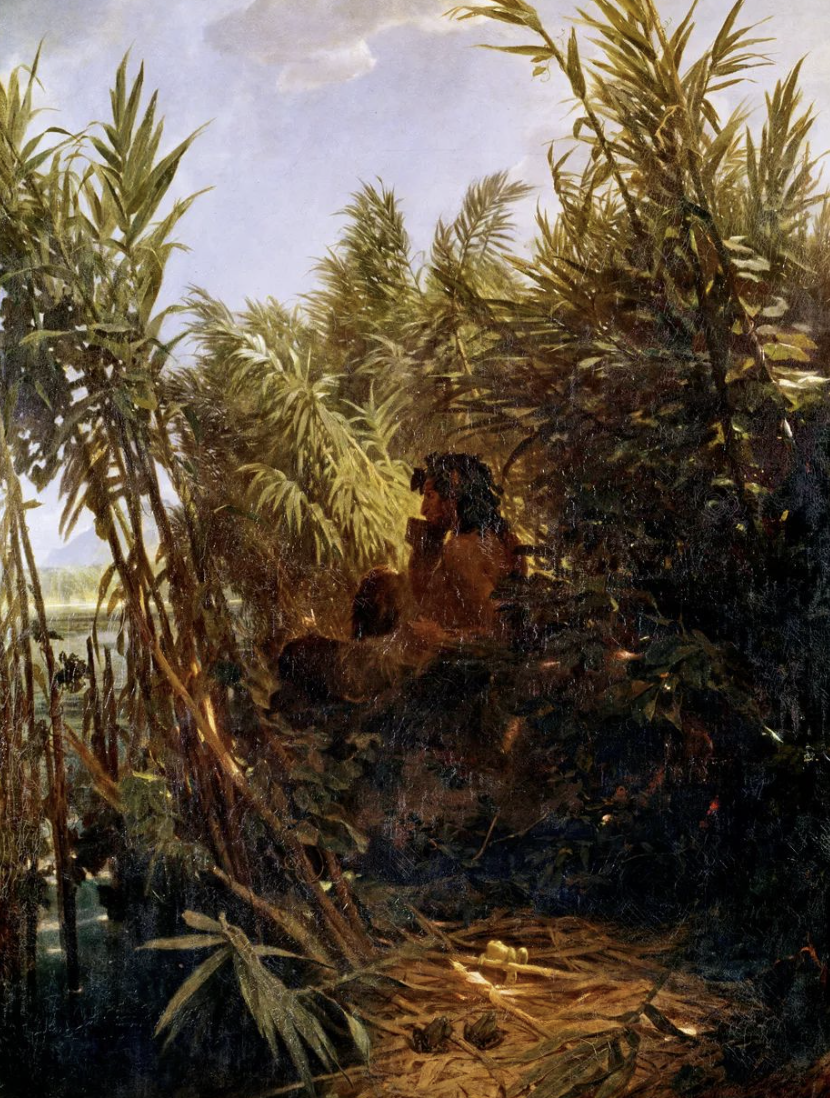
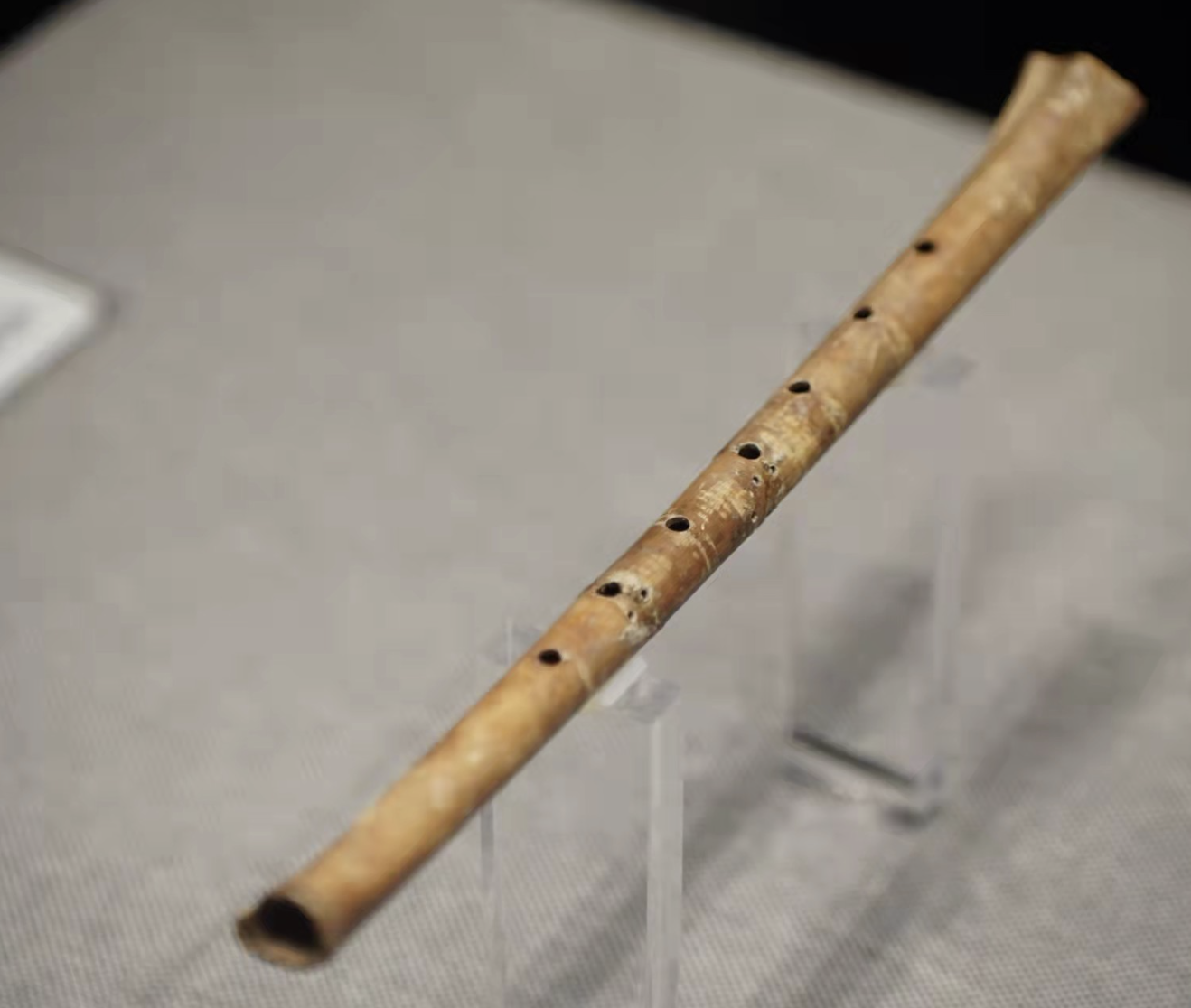
China’s earliest flute was discovered in Jiahu cultural site, named Jiahu gudi, a flute 9000 years old made of bone piece of water bird’s ulna. Ever since then, music played in China was more than melodic enjoyment, but sacred prayers and wishes that carries part of culture and religion. Ever since the Zhou dynasty, ancient folk music was wide-spread among this region, leading to a wide cultural impact.
Later in Tang and Song dynasty, the Chinese system to record music, the gongche spectrum appeared. Different kinds of flute emerged in everyday life during that time, including the nine-hole flute, seven-hole jade flute, etc.
After the Yuan dynasty, which the Chinese society experienced influences from Islam, Tibetan Buddhism, and other western Asian culture. This gave rise to the development of opera, and because of different pitches used in different operas, Chinese bamboo flutes were divided into 2 categories: Bangdi and Qudi. In late Ming Dynasty, western music arrived China, which lead to the development of twelve equal temperament. In term of flute, it was more widely used in court and folk music, reaching its mass audiences until now.
Structure of the flute
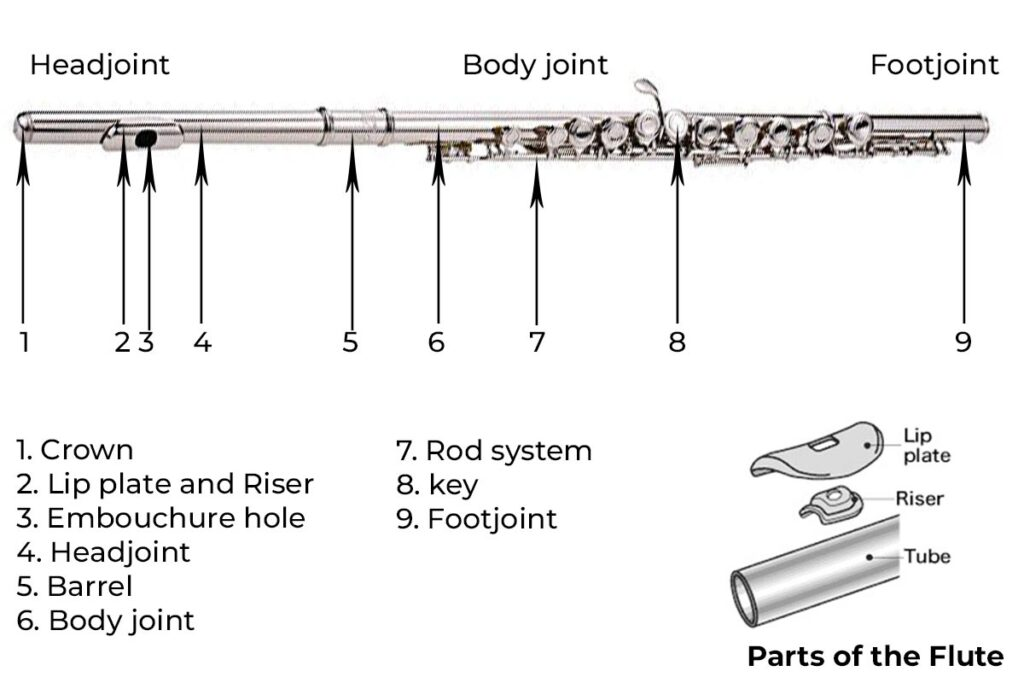
This is the structure of the flute. It could be seen as composed of 3 parts: a steady air supply, which the performer lead the air enter the embouchure hole; a highly nonlinear valve to modulate the flow, and a resonant air column of controllable acoustic length. All these components are under the direct control of the performer.
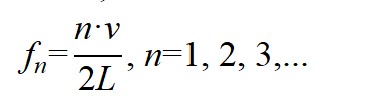
To begin with, approximately the flute could be seen as a cylindrical tube with 2 open ends, so based on theories of resonance, the frequency of the sound will be 1,2,3... half wavelengths in the tube, which is
During performance, the wave of the jet of the performer can be described by the following equation:

Therefore, flute performers will need to adjust their pitch and sound by assuring a jet-wave travel time about half a cycle at a desired frequency by adjusting the lip distance and air velocity during their performances. The blowing pressure, for instance, should be carefully selected by the flutist, and it must rise with frequency.
Material of Structure of Chinese Bamboo Flute
Currently the most common material is bitter bamboo from tongling bridge, Hangzhou, Zhejiang. One of the main advantage of bitter bamboo is its long joint length, so that only a single joint of bamboo could be made into flute. Therefore, there are no need to add another small length of bamboo to lengthen the flute to reach its suitable length, and preventing the flute from cracking up.
Relative to purple bamboo, which has a more viable density, bitter bamboo has a stable, high density. The bamboo itself is think, resilient, and very sensitive to airflow. Based on these advantages, bitter bamboo has been the first one to select by flute makers from Zhejiang and Suzhou.

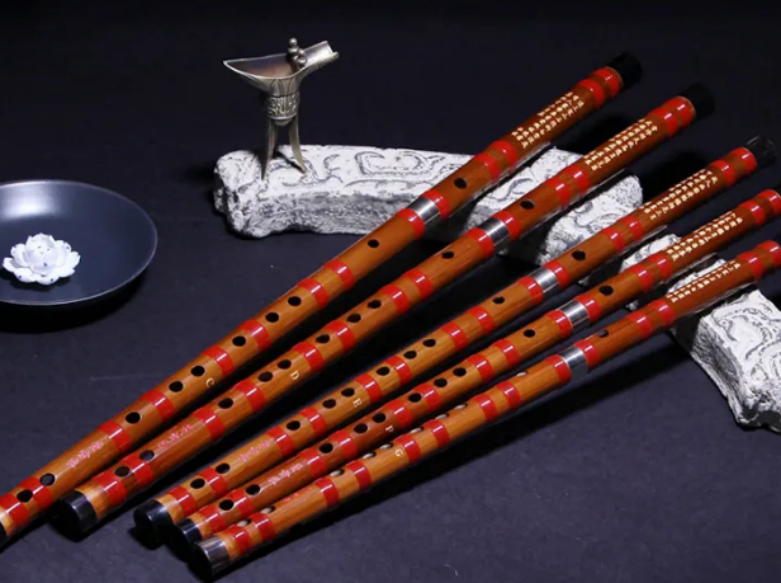
Rather than flute being a fixed-key instrument, Chinese bamboo flutes has a more flexible choices of keys. Common keys include C, D, Eb, E, F, G, A, and these keys were determined by checking the third hole on the flute. Based on the their keys, each flute has its own length and size, ranging from 40 cm to 70 cm.
The classification of Bangdi and Qudi are also classified based on different keys. During the common keys listed, C, D, Eb, and E flutes are classified as Qudi; F, G, A are classified as Bangdi.
The flute film/Dimo
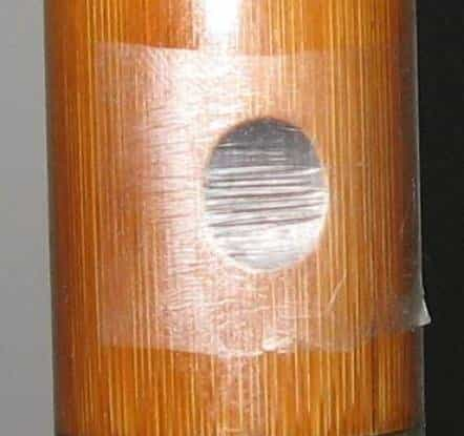
What is flute film?
Both Chinese Bamboo flute and Western flute shared a similar playing technique: the control of lip movements and the air flow itself are also important in Chinese bamboo flute. However, when considering the sound effects, Chinese bamboo flute has its unique flute film,flute diaphragm, or Dimo, that helps the flute to create a light resonating sound.
The film used for flutes could come from reed, bamboo itself, and casing. The most common material is the reed film. Reed film comes from a natural thin layer of film inside the reed stem. Fresh reed film are light, thin, and transparent, and the fibers are elastic.
How to create a flute film
The collection of reed films begins at the 9th Chinese traditional solar terms: Xiaoman. The certain time to collect reed film is also determined by the local climate and environment. Normally the reed that grow in lush and dense area with shallow water without sunlight are selected. Only the upper half of reed are collected. In order to create the film that shown above on the flute, after collect the reed, separation of the film to 2 or 3 sections are needed. After that, using the knife to peel of the outer skin, which will lead to a white layer of film. Later, the new film will be blow with air and then dried, then it will be ready to use.

How to use flute film
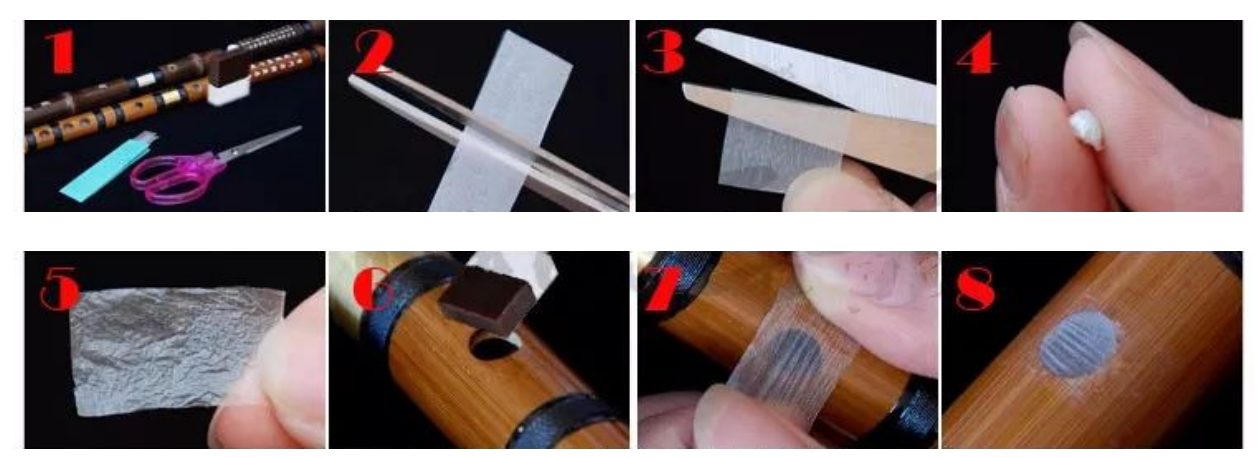
In order to use the flute diaphragm, performers need to stick the flute diaphragm onto the film hole on the flute carefully. To begin with, a section of the film that could fit on the hole should be cut off. Since the film used to have a tube-shape, the next step will be separating at the middle of the tube which brings a thin layer of film.
After that, the film itself cannot stay on the flute, and the usage of glue is necessary. Common glue used in this process are donkey-hide gelatin, peach resin, and bletilla. Donkey-hide gelatin is solid under normal temperature, and it will need water to turn to liquid glue. However, too much water will make the whole diaphragm easy to water, therefore the amount of water will need to be carefully controlled.
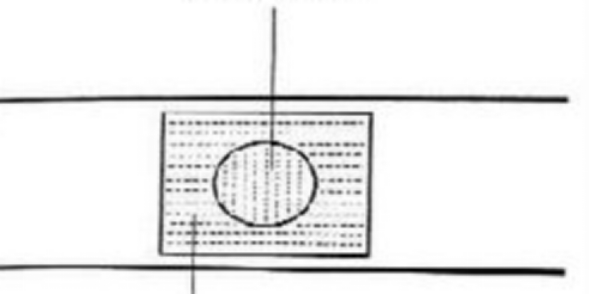
After putting the glue on the surrounding of the film hole, 2 hands are needed on the 2 sides of the film and pull it with a little strength. Therefore, the film is straight and it has small folding on the film. The most ideal way of these folding is that they should be perpendicular withe the film’s original fiber, like the graph is illustrating.
Chacteristics of flute film
Flute film are easily affected by nearby temperature and even the airflow of the performer themselves. When the temperature is hot, the flute diaphragm will be heated and expanded; if the weather is very humid and relatively cold, the flute diaphragm will contract and become soft (Zhou, 2021). Therefore performer will need to adjust their flute film before and after their performance. Usually, before the performance, the flute film are considered soft and needed strength to pull it straight. However, when during the performance when it becomes too rigid and tight, the performer will need to press the flute film several times until it retrieves its oscillating sound back. Tightness is one of the important traits of flute film the performer needs to consider.
Performance of Chinese Bamboo Flute
Similar to early Western flutes, in order to play the semitone, like F under a D key flute, performers will need to cover the hole in a half. However, due to the area the finger might cover will vary, performers will need to carefully control their intonation when performing.
As previously stated, the 2 categories of Chinese bamboo flute, Bangdi and Qudi, each serves different repertoire for different regions. Bangdi, with its higher pitch and higher frequency, served to play Northern folk sound and traditional music, like Northern Bangzi Opera, a kind of music in Shanbei. Qudi, on the other hand, are longer, and as seen through its name, means the “song flute”. It serves primary in Jiangnan Sizhu and Kunqu Opera.
Special notation of Chinese Bamboo flute
Chinese Bamboo flute, like other traditional Chinese instruments, followed their own way of notations other than the normal staff. Since Song dynasty, Gongche spectrum has been the main way to preserve music pieces. On Gongche spectrum, it contains Chinese characters to symbol different notes (Liu, 2020).
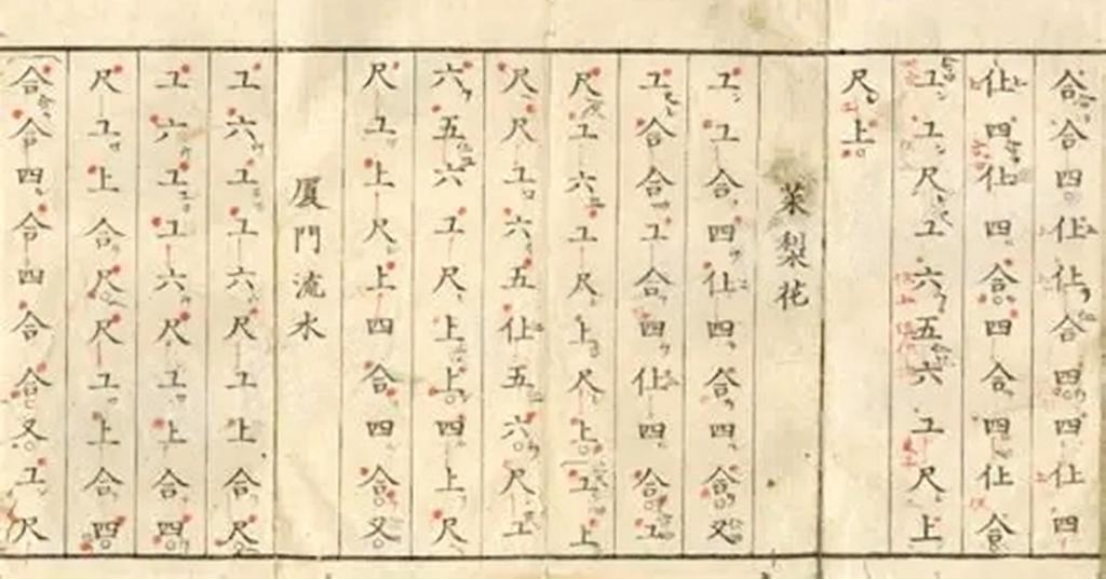

However, Gongche spectrum is not the notation that traditional Chinese music use today. Instead, the common notation use in textbooks are Jianpu, which replace the Chinese characters with numbers from 1 -7.

Other than using numbers, in order to separate different octaves, Jianpu uses dots for indications for octaves. Since the Chinese bamboo flute also have 3 octaves, Jianpu marks the second octave as the middle octave, using simple numbers from 1-7. When reaching to the upper octave, use a upper dot to represent the third octave. Similarly, when reaching to the lower octave, use the dot below the number could represent the first octave.
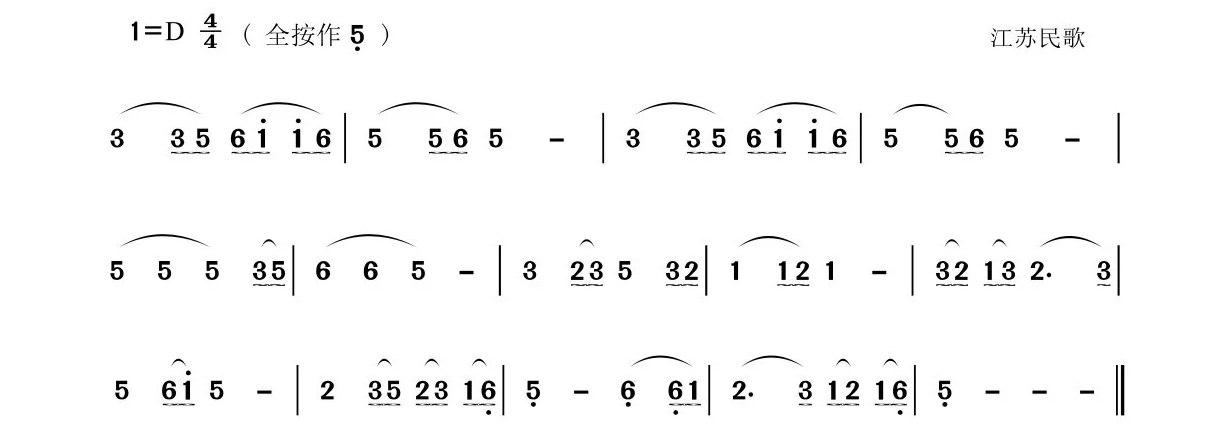
Other than different flutes to perform different keys, in order to perform on different pitches using the same flute, Chinese bamboo flute could change which number represents which notes, like what’s shown in the sample Jianpu first line “1=D”. 1=D means the same of Xiaogong Diao, and according to table 1, Xiaogong means a note below Gong, which also correlates D. Xiaogong Diao also means that the tonic note (all 6 holes covered) as sol (5). Common keys like this includes Zhenggong Diao, which is the tonic note as Re(2),or the G key; and Chizi Diao,which is the tonic note as La(6), or the C key. The different alteration of keys make the notation of flutes different, so many complex notations could be achieved in this 3 octaves.
Special Techniques of Chinese Bamboo Flute
This section combines with my own experiences when playing and comparing the sound effects of the same song when playing the same piece.
Liang Shanbo and Zhu Yingtai
To view the whole paper, please view the link: https://drive.google.com/file/d/1xKr92ar07Rh6malHzXBfJI5pzATDdptY